
 Dansk
Dansk
The article is brought in VikingNyt 2025:2, May 2025.
When summer brings hot days and heatwaves, it often affects both the cows’ feed intake and milk production. But what may be less apparent is that heat stress can also have long-term consequences for unborn calves – especially in late pregnancy. Research shows that calves exposed to heat stress as fetuses may face challenges with health, growth, and milk yield – and the effects can even extend to future generations.
This is a summary of several scientific articles.
The last 8 weeks of pregnancy are crucial
Most studies focus on the final eight weeks before calving, when the fetus experiences its most rapid growth. During this period, the calf typically gains more than half of its birth weight. If the cow or heifer is exposed to heat stress during this phase, her appetite – and consequently feed intake – is reduced. This can mean that the calf doesn’t receive the nutrients it needs in the womb, which can have consequences later in life.
Smaller calves and weaker immune systems
Not only do the calves have lower birth weights – their immune systems also appear to be compromised. Measurements of various immune markers show that calves from heat-stressed cows perform worse, regardless of the quality of the colostrum. This increases the risk of disease and may impair development and later performance in the first lactation – if they even make it that far.
Shorter lifespan and more culling
In a study from Florida, researchers followed the survival of heifers all the way through their first lactation. There were more stillbirths, and only 66% of the calves exposed to fetal heat stress completed their first lactation – compared to 85% in the control group. Many of the heat-stressed heifers were culled before puberty, primarily due to illness or poor growth.
When comparing results across multiple studies, the pattern is clear: Fetal heat stress shortens the cow’s lifespan – on average by up to one year, and reduces productive life by several months.
Risk of lower milk yield
When a heifer fetus is exposed to heat stress, it risks impaired development of udder cells, which can impact future milk production. In a 10-year study from Florida, daughters of heat-stressed cows produced 8% less milk in both their first and second lactation. In the third lactation, the difference was even greater, though the data set was smaller. However, there was no difference in milk fat or protein content.
That said, not all studies show reduced milk yield. German and French studies found no effect, likely because cows in those regions were not exposed to as severe heat stress as in Florida.
Breeding animals harder to get pregnant
Although there is no difference in the age at first insemination, several studies show that heifers and first-lactation cows exposed to fetal heat stress are more difficult to get pregnant. On the other hand, few studies have examined health traits – and those that have, found no significant differences in somatic cell count, mastitis, lameness, or overall antibiotic use.

Effects can be seen all the way into the third generation
While many studies focus on calves that were directly exposed to heat stress in the womb (first generation), newer research shows that the effects can extend to both the second and third generations.
In a U.S. study from Florida, researchers followed the offspring of affected heifers – the second generation – and found that cows produced 4% less milk in their first lactation if their mothers had been born to heat-stressed cows. There was no difference in lifespan, but fewer heifers (60% compared to 75% in the control group) reached their first calving.
Similar results have been found in large studies from Israel and Northern Italy, where a negative impact on milk yield was observed all the way into the third generation – that is, the great-granddaughters of cows that were once exposed to heat stress during pregnancy.
Is heat stress a risk in Denmark?
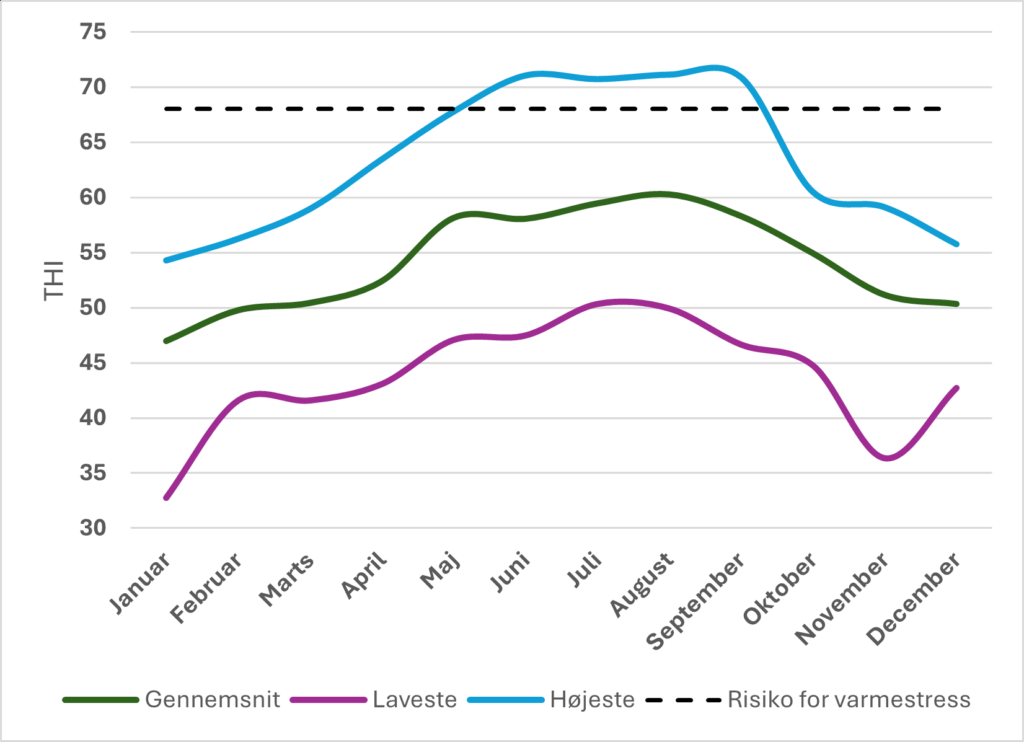
Heat stress is measured using the THI – an index calculated from a combination of temperature and humidity. Cows begin to experience heat stress when the THI exceeds 68 (dotted line). In Denmark, THI calculations for 2024 (based on data from DMI) show that there is no risk at average temperatures (green line). However, on the hottest days between May and October (blue lines), THI levels are high enough that heat stress may occur. That said, in 2024 we have not yet seen THI levels above 80, which is considered severe heat stress.
What can be done to prevent heat stress?
It’s important to ensure adequate airflow and ventilation for dry cows. So if there is no ventilation system or other form of cooling in place, it might be an investment worth considering. Access to an outdoor area with good shade can also be an alternative if barn conditions are difficult to improve sufficiently. A good starting point might simply be to observe the dry cows more closely when temperatures rise, to assess how affected they are by the heat.
Reference list
Ahmed, B. M. S., Younas, U., Asar, T. O., Dikmen, S. E. R. D. A. L., Hansen, P. J., & Dahl, G. E. (2017). Cows exposed to heat stress during fetal life exhibit improved thermal tolerance. Journal of animal science, 95(8), 3497-3503. https://doi.org/10.2527/jas.2016.1298
Dahl, G. E., Tao, S., & Laporta, J. (2020). Heat stress impacts immune status in cows across the life cycle. Frontiers in veterinary science, 7, 116. https://www.frontiersin.org/journals/veterinary-science/articles/10.3389/fvets.2020.00116/full
Holter, J. B., West, J. W., & McGilliard, M. L. (1997). Predicting ad libitum dry matter intake and yield of Holstein cows. Journal of dairy science, 80(9), 2188-2199.
Kipp, C., Brügemann, K., Zieger, P., Mütze, K., Möcklinghoff-Wicke, S., König, S., & Halli, K. (2021). Across-generation effects of maternal heat stress during late gestation on production, female fertility and longevity traits in dairy cows. Journal of Dairy Research, 88(2), 147-153. https://doi.org/10.1017/S0022029921000327
Laporta, J., Fabris, T. F., Skibiel, A. L., Powell, J. L., Hayen, M. J., Horvath, K., … & Dahl, G. E. (2017). In utero exposure to heat stress during late gestation has prolonged effects on the activity patterns and growth of dairy calves. Journal of dairy science, 100(4), 2976-2984. https://www.sciencedirect.com/science/article/pii/S0022030217300772
Laporta, J., Ferreira, F. C., Ouellet, V., Dado-Senn, B., Almeida, A. K., De Vries, A., & Dahl, G. E. (2020). Late-gestation heat stress impairs daughter and granddaughter lifetime performance. Journal of dairy science, 103(8), 7555-7568.
https://www.sciencedirect.com/science/article/pii/S0022030220304483
Macciotta, N. P., Dimauro, C., Degano, L., Vicario, D., & Cesarani, A. (2023). A transgenerational study on the effect of great-granddam birth month on granddaughter EBV for production traits in Italian Simmental cattle. Journal of Dairy Science, 106(4), 2588-2597. https://www.sciencedirect.com/science/article/pii/S0022030223000863
Monteiro, A. P. A., Tao, S., Thompson, I. M. T., & Dahl, G. E. (2016a). In utero heat stress decreases calf survival and performance through the first lactation. Journal of Dairy Science, 99(10), 8443-8450. https://www.journalofdairyscience.org/article/S0022-0302(16)30529-X/fulltext
Monteiro, A. P. A., Guo, J. R., Weng, X. S., Ahmed, B. M., Hayen, M. J., Dahl, G. E., … & Tao, S. (2016b). Effect of maternal heat stress during the dry period on growth and metabolism of calves. Journal of Dairy Science, 99(5), 3896-3907. https://www.sciencedirect.com/science/article/pii/S0022030216300145
Ouellet, V., Boucher, A., Dahl, G. E., & Laporta, J. (2021). Consequences of maternal heat stress at different stages of embryonic and fetal development on dairy cows’ progeny. Animal Frontiers, 11(6), 48-56. https://academic.oup.com/af/article/11/6/48/6469039
Skibiel, A. L., Dado-Senn, B., Fabris, T. F., Dahl, G. E., & Laporta, J. (2018). In utero exposure to thermal stress has long-term effects on mammary gland microstructure and function in dairy cattle. PLoS One, 13(10), e0206046. https://journals.plos.org/plosone/article?id=10.1371/journal.pone.0206046
Tao, S., Monteiro, A. P. A., Thompson, I. M., Hayen, M. J., & Dahl, G. E. (2012). Effect of late-gestation maternal heat stress on growth and immune function of dairy calves. Journal of dairy science, 95(12), 7128-7136. https://www.sciencedirect.com/science/article/pii/S0022030212007126
Vinet, A., Fouéré, C., Cuyabano, B. C. D., Mattalia, S., Vallée, R., Barbat, A., … & Boichard, D. (2024). Long-lasting effects of in utero heat stress on subsequent performances of heifers and primiparous cows. Journal of Dairy Science, 107(12), 11065-11077. https://www.sciencedirect.com/science/article/pii/S0022030224011597
Weller, J. I., Ezra, E., & Gershoni, M. (2021). Broad phenotypic impact of the effects of transgenerational heat stress in dairy cattle: a study of four consecutive generations. Genetics Selection Evolution, 53, 1-12. https://link.springer.com/article/10.1186/s12711-021-00666-7
Zimbelman, R. B., Rhoads, R. P., Rhoads, M. L., Duff, G. C., Baumgard, L. H., & Collier, R. (2009, February). A re-evaluation of the impact of temperature humidity index (THI) and black globe humidity index (BGHI) on milk production in high producing dairy cows. In Proceedings of the Southwest Nutrition Conference (pp. 158-169). Tucson, AZ, USA: USDA Cooperative State Research, Education, and Extension Service (CSREES).