
 Dansk
Dansk
Content from Pfrombeck et al. (2025), Journal of Dairy Science. Read the full article here.
Digital health tools are changing dairy management—but do they pay off? That was the key question addressed in a recent peer-reviewed study, where SimHerd played a central role in evaluating the return on investment (ROI) of sensor-based disease monitoring in dairy herds.
Evaluation og a sensor bolus in a field trail
The study, was conducted by German researchers from Institute für Agricultural Engineering and Animal Husbandry, Bavarian State Research Center for Agriculture and Faculty of Sustainable Agriculture and Energy Systems, University of Applied Science Weihenstephan-Triesdorf in collaboration with SimHerd. It examined a commercial rumen bolus sensor capable of tracking core body temperature and activity levels to detect early signs of common diseases such as: mastitis, hypocalcemia, retained placenta, and claw- and leg problems.
Data was collected over a two-year period from 65 cows at a research and demonstration farm. The system’s detection rates varied across disease types, showing the highest sensitivity for hypocalcemia and retained placenta (up to 64%), and the lowest for lameness-related conditions.
Modeling Economic Outcomes
To assess the financial impact of using such a sensor system, researchers used the SimHerd Expert model to simulate herd performance across three herd health scenarios: poor, average, and good health.
A panel of nine practicing veterinarians provided expert estimates on how earlier detection might affect key health parameters, including: treatment costs, days of milk withdrawal, somatic cell count (SCC), and risk of mild vs. severe diseases cases.
These values were used to parameterize SimHerd, which then simulated 10,000 iterations per scenario to estimate changes in gross margin (GM) with and without the sensor system. The analysis also accounted for investment costs, potential labor savings, and time spent following up on false-positive alerts.
Key Findings: Economic Return Varies with Herd Health
The economic outcomes differed significantly depending on the herd’s baseline health:
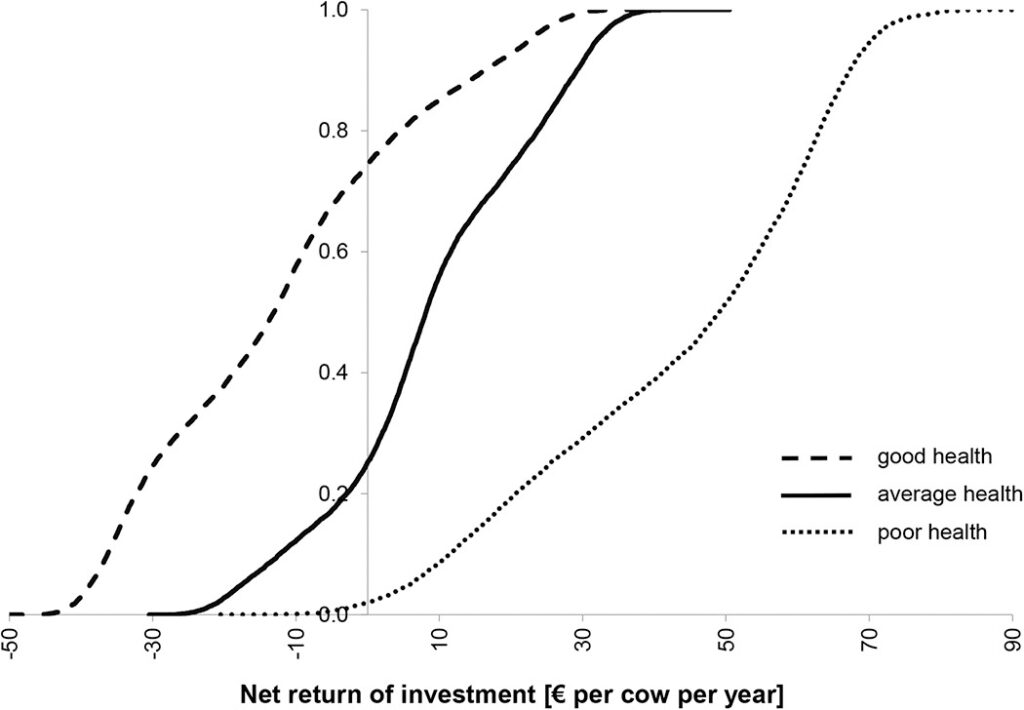
🟢 Poor-health herds: Net returns of up to €119 per cow/year and nearly 100% chance of a positive ROI.
🟡 Average-health herds: Variable but often positive returns, depending on assumptions about labor and sensor accuracy.
🔴 Good-health herds: Lower or even negative returns, due to fewer disease events to detect early.
The figure from the study illustrates this clearly: the probability of a positive economic return is substantially higher in herds with poorer health. In contrast, up to 75% of simulations showed a negative return in already healthy herds.
Practical Implications for Dairy Farmers
The findings suggest that sensor systems are most economically viable in herds facing higher disease pressure. For well-managed, healthy herds, the benefits may not yet outweigh the costs—particularly if detection sensitivity and specificity remain limited.
By contributing to this study, SimHerd once again demonstrated its value as a robust decision-support tool, enabling farmers, veterinarians, and advisors to:
-
Evaluate new technologies in a risk-based, evidence-driven framework
-
Simulate herd-specific scenarios before making high-cost investments
-
Support strategic planning based on data rather than assumptions
Simulate Before You Invest
Are you considering investing in a sensor system? With tools like SimHerd, you don’t have to guess. Farmers can model their own herd dynamics and determine whether an investment is likely to pay off—before committing capital. Contact us for more information.